Project Brief
To design an aluminium liquid-cooling cold plate for EV battery packs, and optimise it using computational analysis to improve thermal uniformity while reducing hydraulic resistance and pressure drop.

Focus
Fluid Mechanics · CFD · Thermal Management
Timeline
4 Weeks · 2026
Toolkit
SolidWorks · ANSYS Discovery · Figma
Generated a 640 Pa pressure drop caused by inlet jet impingement and sharp bend friction losses.
Reached a peak velocity of 0.61 m/s, causing uneven momentum distribution and flow separation.
Maintained a 46°C peak temperature but showed poor thermal uniformity and localised channel imprinting.






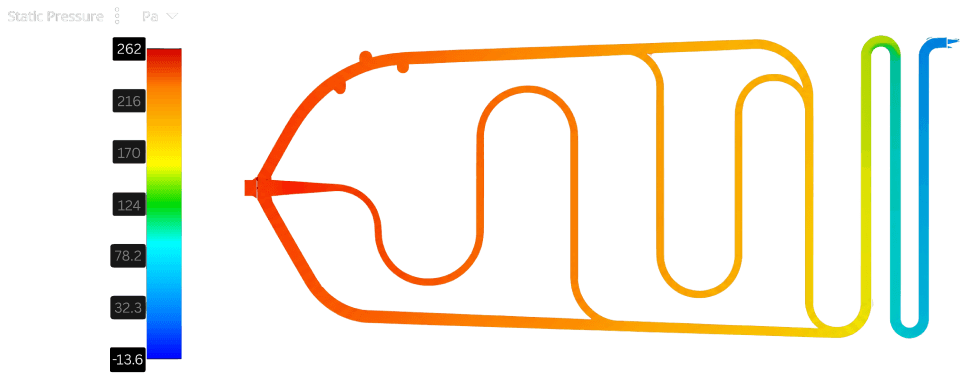
Cut hydraulic resistance by 63% down to 236 Pa, reducing the required pumping power.
Lowered peak velocity to 0.34 m/s to eliminate high-pressure bottlenecks and smooth the coolant flow.
Achieved superior thermal uniformity, taking a higher 49°C peak temperature as a
trade-off for the hydraulic efficiency gains.