Rhythm Rush
A motion-tracked dance game that turns slow event queues into social spaces.

Focus
Human Centred Design · Interaction
Design · User & Stakeholder Research
Timeline
16 Weeks · 2026
Toolkit
Fusion 360 · Lo-fi Prototyping · Behavioural Testing
Fusion 360 · Lo-fi Prototyping · Behavioural Testing
The Problem
Queues put people side by side, yet completely disconnected.
80%
Of queuers say long queues are one of the “most significant drawbacks” of attending events.
97%
of queuers do not feel excited to queue.
0%
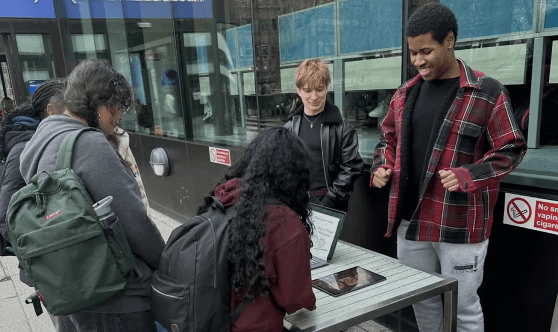
of visitors approached a stranger during our Outernet observation
How might we design a gamified experience that naturally encourages social interaction in queues, without breaking the flow?
The Process
From 12 ideas to one tested design
1 - Research
Field observations, street interviews, surveys and public experiments to find the barriers to talking to strangers.
2 - Ideation
Generated 12 concepts, then narrowed them using user-centred and engineering criteria, supported by low-fidelity prototyping.
3 - Prototyping
Prototyped body tracking, on-screen UI, a full-scale mock-up and a simulated queue, each tested with users.
4 - Validate
Tested at every stage from, emotional response testing (PREMO), Harris profiles, stakeholder role-plays and queue simulations.


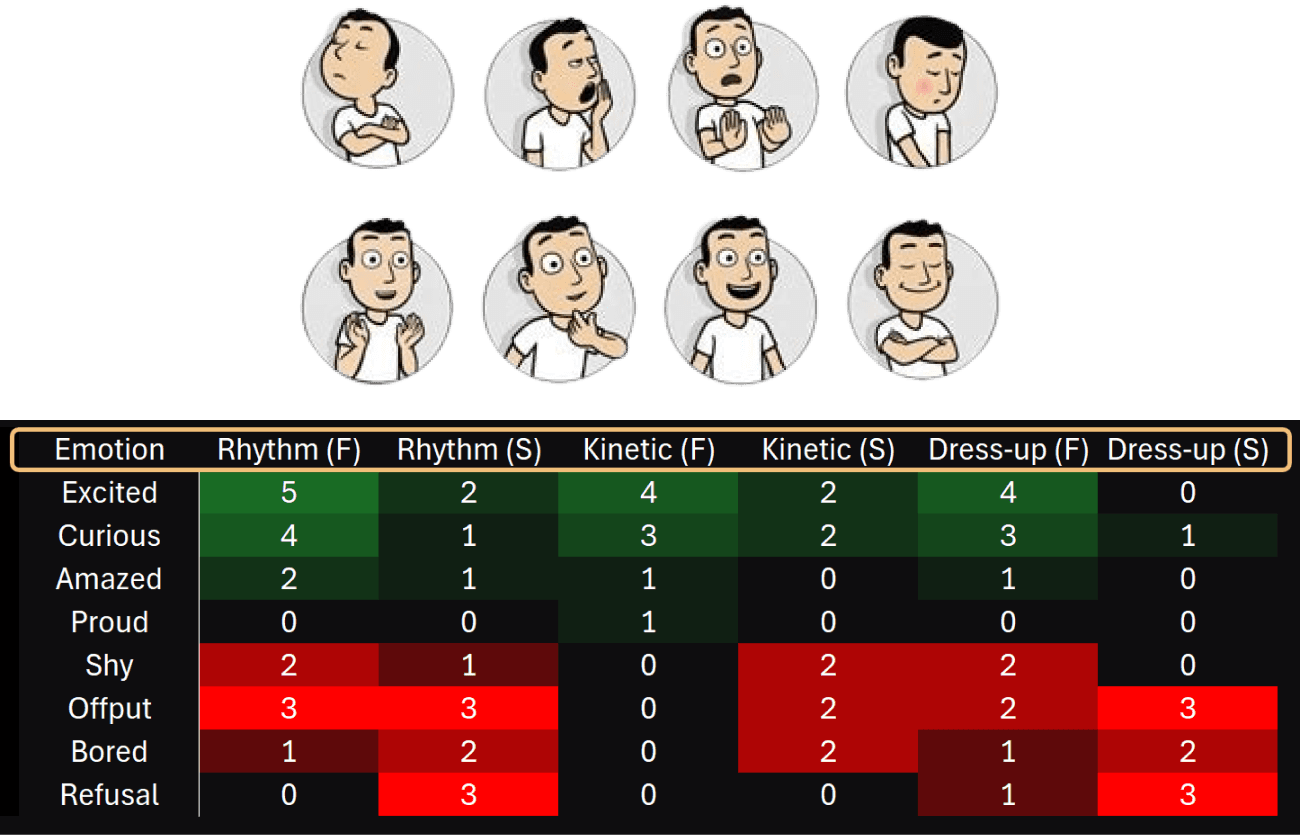
21 Interviews · 55 A/B Test participants
12 concepts -> 6 concepts -> 4 -> 3 -> 1
Tracking · Visuals · UI · Mock-up
5+ Validation methods
Key Insight
Interactions doubled when a game was involved
In our public experiment, a shared game gave strangers a low-pressure reason to engage, and spectators stayed to watch.
My Contribution
What I did
1 - Co-Led User Research
Ran field observations, interviews, surveys and public interaction experiments to identify social barriers and engagement patterns, defining the user needs and design requirements the team built on.
2 - Co-led Concept & Interaction design
Used co-design workshops, low-fidelity prototypes, journey mapping and emotional analysis to evaluate 12 concepts and refine the experience, then presented the findings and final design to an audience.

The solution
A dance battle built into the queue itself

Credits to Amarie Fasoro, a member of the team, for making the amazing UI and blender characters for the game.
What testing changed
User feedback shaped the final design
We found
In the queue simulation, people felt rushed and congestion built up.
So we added
A spectator zone, a wider space, and a prompt at the end of each song so players can step out or swap in.
We found
Role-play showed people feared losing their spot in the queue.
So we added
A junction system to play, watch or bypass without penalty.
We found
PREMO testing showed the game felt intimidating and unclear
So we added
Playful avatars, a minimal UI and an animated dance guide
Reflection
What I learned and What I'd do differently
Learned 01
What people say and do can differ
Tap to flip ↻
Learned 01
At Outernet 52% said they'd be comfortable starting a conversation, yet 0% did, so I now trust what people do as much as what they say.
↻ Tap to flip back
Learned 02
Cheap, early tests can change a project.
Tap to flip ↻
Learned 02
A table, a high-five and a game showed interactions doubled with play, which made the game the core of the deign rather than an add-on.
↻ Tap to flip back
Next Time 01
Test in a real queue.
Tap to flip ↻
Next Time 01
Our simulation was controlled, so I'd test at a real event to see how crowds and noise affect behaviour.
↻ Tap to flip back
Next Time 02
Bring stakeholders in earlier.
Tap to flip ↻
Next Time 02
Role-play revealed the fear of losing your place, inspiring our junction system. I'd explore this earlier to shape the concept sooner.
↻ Tap to flip back
© 2026 Ikem Enebeli.