

Focus
FEA · Fatigue Analysis · Modal Analysis
Timeline
8 Weeks · 2026
Toolkit
Fusion 360 · ANSYS Mechanical · Overleaf
Key Design Criteria
Design Criteria
Requirement
Materials
Epoxy Carbon Woven Prepreg Composite (230 GPa)
Aluminium Alloy 2014-T4
Lightweight Structure
Under 750 g
Durability
Minimum fatigue life of 1 million cycles or a 3x safety factor against peak stress
Vibrational Stability
Fundamental frequency > 50 Hz to minimise the risk of resonance during running
Boundary Conditions & Loading
Fixed Constraint: The upper attachment face was fixed to represent the connection between the blade and prosthetic socket.
Combined Loading: A 2100 N vertical force and 500 N horizontal force were applied to the contact region to represent combined ground-reaction loading during running.

Boundary Conditions on the initial Blade Design


Modal Analysis on the CFRP C-Blade
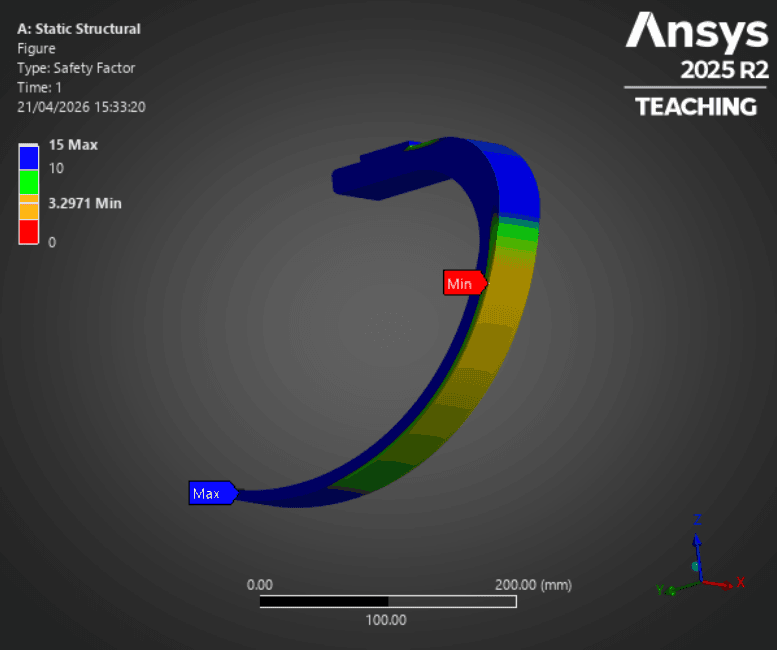
Safety Factor Analysis on the CFRP C-Blade
Lightweight Dynamic Performance: At 0.685 kg, the CFRP blade achieves a 78.9 Hz natural frequency, well above the ~50 Hz running excitation frequency, showing an effective stiffness-to-weight balance.
Reduced Stress Concentration: Increasing the fillet at the blade's straight-to-curve transition by 15% reduced peak stress to 244.16 MPa, resulting in a 3.30× safety factor against material failure.

Modal Analysis on the Aluminium Alloy C-Blade

Fatigue Analysis on the Aluminium Alloy C-Blade
Stiffness-to-Mass: The 111.08 Hz natural frequency reflects aluminium's high stiffness relative to its mass, consistent with ( fₙ ∝ √(k/m) ).
Fatigue Performance: The 3.5 million cycle fatigue life results from reduced stress concentrations at the critical bending transition, providing substantial durability under repeated loading.