Thermofluids Focused Sedan Redesign

Three-quarter render of the 3D-printed car design

Focus

Mechanical Design, Aerodynamics

Timeline

6 Weeks · 2026

Toolkit

Fusion 360 · ANSYS Fluent · 3D Printing

Project Aims

Project Aims

Reduce Rear Flow Separation

Design passive rear-body contours to increase base pressure and lower high-speed cruising drag.

Improve Underbody Pressure Recovery

Manage underfloor airflow to ensure smooth diffuser transitions and better rear flow integration.

Design an Integrated Passive System

Implement simple, lightweight flow-guiding features to maximise efficiency without active aero complexity.

Optimise High-Speed Wake Control

Stabilise the unsteady rear wake to minimise the vehicle's drag sensitivity to varying speeds and crosswinds.

CFD Images:

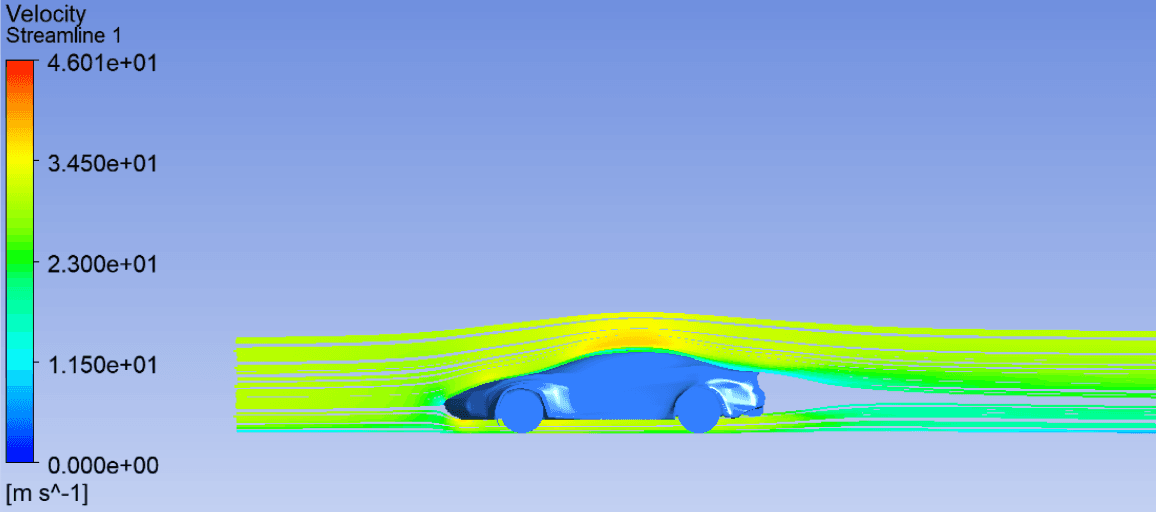
Iteration 1: Cd ~ 0.3823 Cl ~ 0.0887

  • The front bumper generated a strong stagnation region, while the wheels created localised high-pressure zones, both of which contributed to excessive pressure drag.


  • The design suffered from early airflow separation along the rear slope, leading to a sustained rear wake with poor pressure recovery.


  • Accelerated airflow over the roof reduced static pressure, causing slight lift that worked against the vehicle's high-speed stability.

Iteration 1: Cd ~ 0.3823, Cl ~ 0.0887

Iteration 1:
Cd ~ 0.3823, Cl ~ 0.0887

  • The front bumper generated a strong stagnation region, while the wheels created localised high-pressure zones, both of which contributed to excessive pressure drag.


  • The design suffered from early airflow separation along the rear slope, leading to a sustained rear wake with poor pressure recovery.


  • Accelerated airflow over the roof reduced static pressure, causing slight lift that worked against the vehicle's high-speed stability.

CFD Images:

CFD Images:

Iteration 2: Cd ~ 0.3462, Cl ~ 0.0812

Iteration 2:
Cd ~ 0.3694, Cl ~ 0.0713

  • The front bonnet was lowered and the front airflow guides were removed, which eliminated the high-pressure stagnation zones around the wheels and reduced front-end drag.


  • The overall vehicle height was lowered and the body taper was smoothed, successfully reducing the projected frontal area by 2%.


  • By shortening the rear profile and refining the body contouring, the design achieved a smoother pressure recovery and improved streamline attachment, which successfully delayed airflow separation and minimised the overall wake size.

CFD Images:

CFD Images: